Capocchino
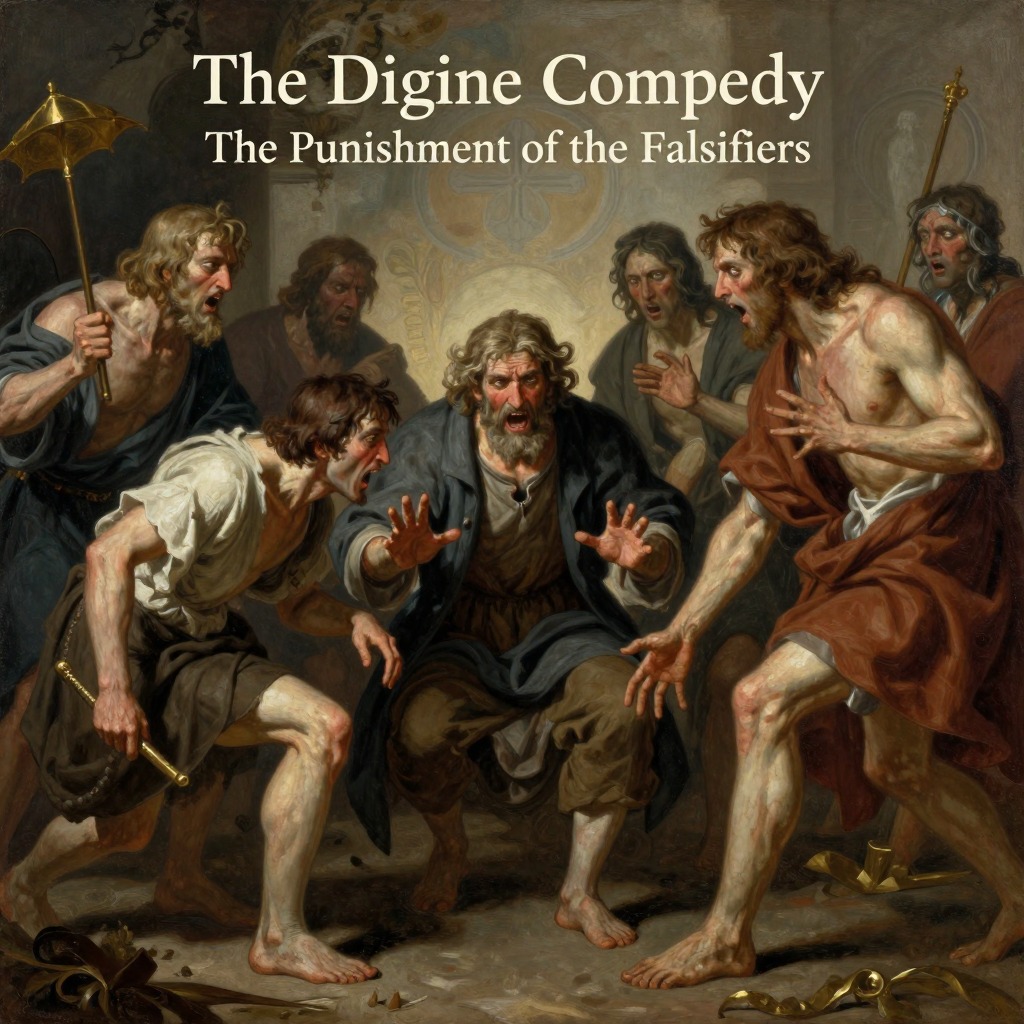
Capocchino is a minor but vividly drawn figure in Dante Alighieri's Inferno, a damned soul consigned to the tenth and final Bolgia of Malebolge, where falsifiers and forgers suffer eternal torment. He appears in Canto XXIX as one of two leprous shades leaning against each other, their bodies covered from head to foot with scabs. His punishment—a loathsome, itching disease that he endlessly scratches with his nails—is a precise instance of contrapasso, the law of symbolic retribution that governs Dante's Hell: as he falsified metals in life, so his body is now falsified and corrupted by disease. Capocchino serves as a foil to the more famous sinners of the Bolgia, and his brief exchange with Dante reveals both his personal history and his bitter commentary on the vanity of human achievement.
Identity and Background
Capocchino was a Sienese alchemist who practiced the fraudulent transmutation of metals. He identifies himself to Dante as "Capocchio's shade, / Who metals falsified by alchemy" (Inferno XXIX, lines 136-137). He claims to have been a "skilful ape of nature" (Inferno XXIX, line 139), a phrase that captures his pride in his craft even as it acknowledges its artificiality. His name is sometimes rendered as Capocchio, and he is one of several Sienese figures whom Dante encounters in the tenth Bolgia, alongside Griffolino d'Arezzo, who was burned at the stake for claiming to be able to fly. Capocchino's crime is specifically alchemical forgery—the attempt to create counterfeit gold or silver through fraudulent means—rather than the more general falsification of coinage or documents.
Punishment and Contrapasso
In the tenth Bolgia, the falsifiers are afflicted with a variety of loathsome diseases. Capocchino and his companion are covered with scabs, which they scratch with their nails "in fashion as a knife the scales of bream, / Or any other fish that has them largest" (Inferno XXIX, lines 82-83). The itching is so intense that they "never saw I plied a currycomb / By stable-boy for whom his master waits" (Inferno XXIX, lines 76-77). This punishment mirrors their sin: as they corrupted the natural order of metals by pretending to transform base substances into precious ones, so their own bodies are corrupted and made base by disease. The contrapasso is both physical and moral—the falsifier's art, which sought to deceive nature, is repaid by a condition that makes the body itself a site of deception and decay.
Encounter with Dante
Dante first notices Capocchino and his companion when they are "sitting leaned against each other, / As leans in heating platter against platter" (Inferno XXIX, lines 73-74). Virgil instructs Dante to speak with them, and Capocchino responds to Dante's questions. He reveals that he was from Siena and that he was burned at the stake by Albert of Siena for his alchemical frauds, though he insists that the execution was not for his alchemy but for a jest he made about being able to fly. He is condemned to the tenth Bolgia by Minos for his alchemical practices, not for the jest that led to his death. Capocchino's tone is bitter and sardonic; he mocks the vanity of the Sienese, singling out the spendthrift Stricca, the extravagant Niccolò, and the squanderer Caccia d'Ascian, before identifying himself.
Thematic Significance
Capocchino embodies the theme of artistic and intellectual fraud that pervades the tenth Bolgia. His claim to be an "ape of nature" echoes the medieval view that alchemy, when practiced deceptively, was a perversion of the natural order—a sin against God's creation. His punishment, a disease that makes him scratch himself like an animal, reduces him to a state below humanity, just as his art reduced the noble metals to base counterfeits. Capocchino also serves as a mirror for Dante's own artistic ambitions: the poet, who seeks to transform language into truth, contrasts with the alchemist, who sought to transform matter into falsehood. In this way, Capocchino's brief appearance reinforces the Comedy's larger meditation on the relationship between art, truth, and moral responsibility.